The Well-Appointed Pour: Curating a Home Bar That Transforms Every Gathering Into an Occasion
There was a time in American social life when the home bar was as carefully considered as the dining room table — when the selection of spirits, the quality of the glassware, and the skill of the host's hand behind the shaker were understood to be expressions of character and hospitality in equal measure. That era, which reached its apex in the mid-twentieth century and then receded somewhat in the decades that followed, is experiencing a vivid and thoroughly welcome resurgence.
Across the country, a new generation of style-conscious hosts is rediscovering what their grandparents understood instinctively: that the art of the well-made cocktail, served in beautiful surroundings, is itself a form of performance. The home bar, at its finest, is not merely a place to store bottles. It is a stage.
The Return of Cocktail Culture
The renewed American fascination with sophisticated home entertaining did not emerge in a vacuum. The craft cocktail movement, which took root in cities like New York, Chicago, and San Francisco over the past two decades, reintroduced the public to the pleasures of the thoughtfully made drink — the careful balance of spirit, sweetener, bitters, and citrus; the theater of the proper shake or stir; the significance of the correct glass. What began in high-end bars and speakeasy-revival establishments has migrated, naturally and inevitably, into the home.
Simultaneously, a broader cultural appetite for what might be called considered living — the deliberate curation of one's domestic environment as an extension of personal aesthetic — has made the home bar a natural object of attention. For those who approach their homes as living expressions of their taste, leaving the bar to chance is simply not an option.
Building the Foundation: Glassware as Object of Desire
No element of the home bar communicates refinement more immediately than the glassware. The right glass does not merely contain a drink; it completes it. And for the host with an eye toward vintage glamour, the selection of proper vessels is an opportunity for genuine connoisseurship.
The coupe glass — that shallow, broad-bowled stemmed glass with its origins in nineteenth-century Champagne service — is perhaps the single most evocative piece in the vintage-inspired bar arsenal. Its elegant geometry suits everything from a classic Daiquiri to a properly made Sidecar, and its visual profile alone sets a tone of occasion. Seek out genuine vintage coupes at estate sales, antique markets, or specialty retailers; a mismatched set of six can be far more charming than a perfectly uniform dozen.
The Nick and Nora glass, a smaller, more refined stemmed vessel named for the fictional cocktail-loving couple of The Thin Man films, has enjoyed a particular renaissance among cocktail enthusiasts for its ideal proportions and its unambiguous old-Hollywood associations. Paired with a crystal-clear, properly chilled cocktail, it is nearly impossible to improve upon.
For spirits served on the rocks or for the classic Old Fashioned, a substantial, heavy-bottomed lowball glass — ideally in cut crystal — conveys the proper sense of gravitas. And for Champagne service, the flute remains the functional choice, though the coupe makes a compelling aesthetic argument for its reinstatement.
Invest in quality over quantity. Six exceptional glasses will serve you better than twenty adequate ones.
The Bar Cart as Aesthetic Statement
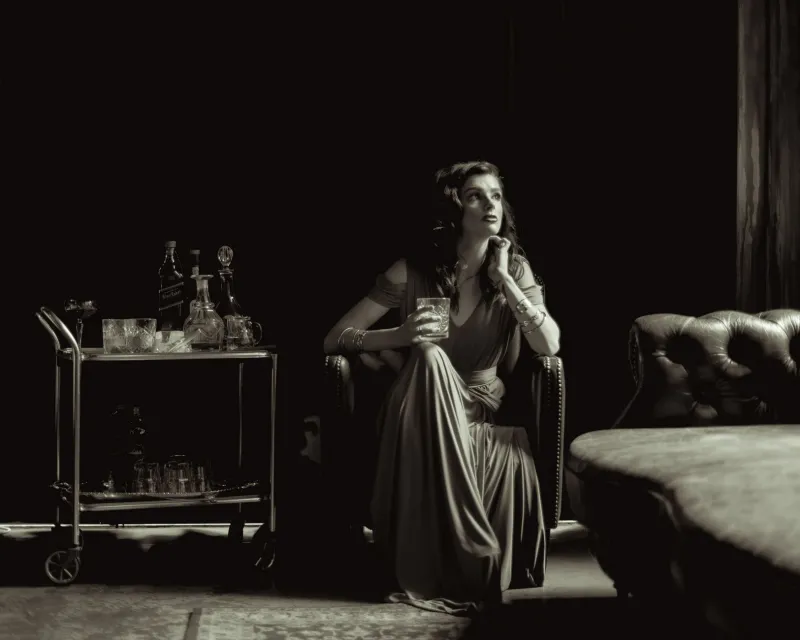
The bar cart is, without question, the most visually prominent element of the home bar setup, and it deserves to be treated accordingly. When styled with intention, it functions simultaneously as a functional workspace and a piece of decorative sculpture — a vignette that communicates the host's aesthetic sensibility before a single drink is poured.
For the vintage-inspired approach, the art deco bar cart — characterized by clean geometric lines, brass or gold-toned metalwork, and glass or mirrored shelving — is the gold standard. These can be found in reproduction form from a number of American home furnishings retailers, or sourced as genuine vintage pieces from dealers specializing in twentieth-century decorative arts.
Styling the cart requires the same editing instinct that governs a well-curated wardrobe. Do not crowd every available surface. Instead, arrange a thoughtfully selected grouping of bottles — three to five of exceptional quality and visual interest, chosen for both their contents and their design — alongside the essential tools: a proper mixing glass, a long-handled bar spoon, a Hawthorne strainer, and a well-balanced jigger. A small ice bucket in silver plate or polished stainless steel adds both function and visual weight.
Allow the glassware to be visible — displayed on the lower shelf or arranged on a small mirrored tray — and add one or two considered decorative objects: a vintage cocktail recipe book, a small arrangement of fresh botanicals, a single extraordinary piece of barware that merits attention on its own terms.
The Cocktail List: Classic Foundations, Modern Sensibility
The best home bar requires not only beautiful equipment but a repertoire of drinks that can be executed with confidence and offered with pride. The following selections balance historical pedigree with contemporary relevance — each a genuine classic, each susceptible to the kind of thoughtful modern interpretation that keeps them feeling alive rather than merely nostalgic.
The Martini, Revisited The Martini remains the apex of the stirred cocktail tradition, and its preparation is a statement of values. A proper Martini — gin-forward, ice-cold, stirred to the precise point of dilution, garnished with either a lemon twist or a quality olive — requires no improvement. The modern host might, however, explore the use of a small-batch American gin in place of the traditional London Dry style, introducing botanical complexity while honoring the form.
The Paper Plane A more recent entry into the canon, this equal-parts cocktail — bourbon, Aperol, Amaro Nonino, and fresh lemon juice — has earned its place among the classics through sheer elegance of construction. It is accessible, visually beautiful in a coupe, and consistently impressive to guests encountering it for the first time.
The Bees Knees A Prohibition-era original, the Bees Knees combines gin, fresh lemon juice, and honey syrup into a drink of remarkable brightness and balance. Its vintage credentials are impeccable, and the use of a high-quality local honey — American producers offer extraordinary regional varieties — makes it feel both rooted in tradition and genuinely of the present moment.
The Improved Whiskey Cocktail For those who favor depth over brightness, this nineteenth-century precursor to the Old Fashioned — rye whiskey, maraschino liqueur, absinthe rinse, and Angostura bitters — offers extraordinary complexity in a deceptively simple format. Served in a chilled lowball glass over a single large ice cube, it is the very definition of understated sophistication.
Hosting as Performance
Ultimately, the well-appointed home bar is in service of something larger than the sum of its beautiful parts. It is in service of the experience of the guest — of the feeling, upon entering a room and being offered something exquisitely made and thoughtfully presented, that they are somewhere worth being.
The host who approaches entertaining with the same seriousness of purpose that a stylist brings to a wardrobe, or that a designer brings to an interior, understands this implicitly. Every detail — the chill of the glass, the clarity of the ice, the precise balance of the drink, the elegance of the setting in which it is offered — contributes to a total impression that guests will carry with them long after the evening has ended.
This is cocktail culture at its finest: not mere drinking, but the creation of atmosphere, memory, and grace.