First Impressions, Lasting Elegance: How Your Foyer Reveals Everything About the Home Within
There is a particular kind of power in the moment a guest crosses your threshold. Before they have settled into a chair, accepted a drink, or exchanged pleasantries, they have already formed a deeply felt impression — not of you, necessarily, but of the world you have chosen to inhabit. The foyer, that liminal corridor between the outside world and your private sanctuary, is the author of that impression. And yet, it remains one of the most chronically underestimated spaces in American home design.
At Dita's Domain, we hold a firm conviction: intentional living begins at the door. The foyer is not a waiting room. It is not a repository for umbrellas and forgotten mail. It is, at its finest, a micro-manifesto — a concentrated expression of the aesthetic values and personal philosophy that govern every room beyond it.
The Entryway as Editorial Statement
Consider, for a moment, what your current entryway communicates. Is it a hurried afterthought, or does it extend a deliberate welcome? The most memorable homes — the ones guests speak of long after the evening has ended — share a common thread: their entryways feel considered. There is a coherence to them, a sense that someone made choices rather than simply allowing things to accumulate.
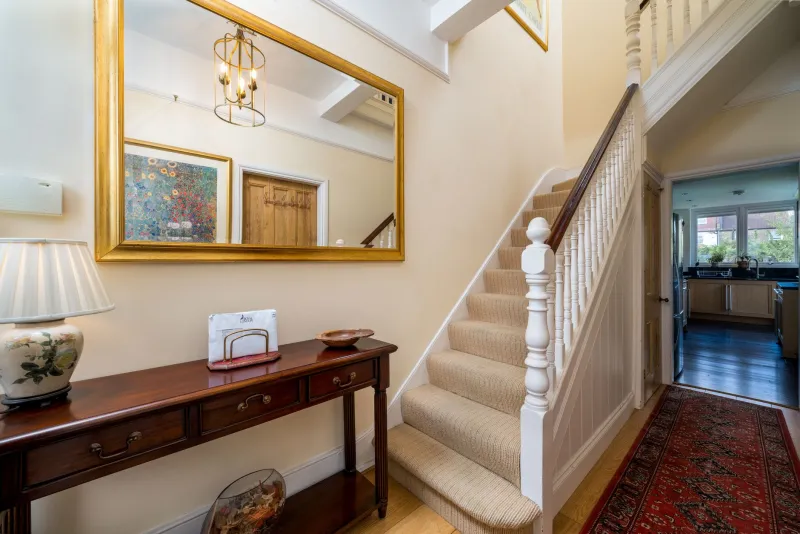
This is the foundational principle of foyer design: every element should be chosen, not merely placed. A narrow console table positioned against the wall is not just a surface for keys; it is an opportunity to establish scale, introduce a material palette, and signal the design language of the rooms that follow. A linen-colored linen runner underfoot does not merely protect hardwood floors — it softens the transition from exterior to interior, from the rushed pace of daily life to the considered calm of home.
Lighting: The Single Most Transformative Element
If there is one investment that yields disproportionate returns in an entryway, it is lighting. A well-chosen fixture — whether a sculptural pendant, a pair of sconces flanking a mirror, or even a low-hanging lantern in the manner of classic American Federal architecture — elevates the entire space with an authority that furniture alone cannot achieve.
The key is to resist the purely functional impulse. Recessed lighting, while practical, rarely creates the sense of occasion that a foyer deserves. Instead, consider a fixture that operates as an object of interest in its own right: a hand-blown glass pendant in amber or smoke, a brass chandelier with genuine patina rather than a factory finish, or a sculptural ceramic sconce that doubles as art. The light it casts should be warm and layered — never clinical, never flat.
Dimmer switches, often overlooked, are among the most quietly luxurious additions one can make. The ability to modulate the atmosphere of an entryway depending on the hour or occasion is a small sophistication with outsized effect.
The Mirror: Functional Luxury at Its Most Eloquent
Few objects serve the dual mandates of beauty and utility as gracefully as the foyer mirror. Practically speaking, it offers a final moment of self-appraisal before departure and creates the illusion of depth in what is frequently a compact space. Aesthetically, it acts as a frame — for light, for the objects surrounding it, and for the person standing before it.
The scale of the mirror matters enormously. An undersized mirror reads as tentative; an oversized one commands attention in the most satisfying way. Antique mirrors, with their foxed and silvered imperfections, carry a history that new reproductions cannot replicate. They suggest a sensibility that values the authentic over the merely fashionable — a distinction that discerning guests invariably notice.
Curated Objects and the Art of Restraint
The temptation in any design endeavor is to fill space. The discipline — and the artistry — lies in knowing what to leave out. A foyer that attempts to say too much ultimately says nothing at all. The most compelling entryways operate on the principle of the well-edited shelf: every object earns its place.
A single piece of original art, positioned at eye level, communicates more about the inhabitant's taste than an entire gallery wall of prints. A ceramic vessel of unusual provenance on a console table invites curiosity. A stack of beautifully bound books — chosen for their content as much as their spines — suggests a life engaged with ideas.
What these objects share is intentionality. They were not placed because they were available; they were chosen because they belonged. This is the quiet confidence of genuinely sophisticated design, and it is felt immediately upon entry, even if the visitor could not articulate precisely why.
Functional Elements That Refuse to Compromise
Practicality and elegance need not be adversaries. The foyer, perhaps more than any other room in the house, must perform — accommodating coats, bags, shoes, and the general detritus of daily American life — while maintaining its composure. The solution is not to hide function, but to elevate it.
A substantial hook rail in unlacquered brass, for instance, performs the same task as a plastic organizer from a big-box store, but does so with an entirely different register of intention. A handsome tray — lacquerware, woven leather, or hammered metal — corrals keys and cards without reducing the aesthetic to something purely utilitarian. A low bench upholstered in a durable yet beautiful fabric offers a place to remove shoes without the visual disruption of a purely functional piece.
Storage, when necessary, should be built-in or otherwise integrated with care. Freestanding coat racks and wire shoe organizers, however convenient, tend to undermine the atmosphere an entryway works to establish. If the budget allows for a single custom piece, the foyer is where that investment is most visible and most valued.
Color, Material, and the Logic of Continuity
The foyer exists in relationship to the spaces it introduces. Its palette, materials, and mood should feel like the opening note of a piece of music — distinct enough to create a sense of arrival, yet harmonious with what follows. A dramatic, deep-walled entry — in a saturated navy, a warm charcoal, or an enveloping forest green — can be enormously effective, provided the adjacent rooms are in conversation with that choice rather than at odds with it.
Materials deserve equal consideration. Stone or tile flooring in an entryway, for example, establishes a sense of permanence and ease of maintenance, while also creating a clear sensory transition from the exterior. The introduction of natural materials — rattan, linen, marble, unlacquered metals — grounds the space in something tactile and genuine, a quality that resonates far more than any trend-driven choice.
A Space That Knows Its Purpose
The most enduring homes are those in which every space has been considered with the same care and intention as the most public rooms. The foyer, in this sense, is not a preamble — it is a promise. It tells your guests, before a single word is spoken, that the experience they are about to have has been thoughtfully prepared. It tells you, each time you return home, that you have arrived somewhere worthy of the life you are building.
Designing it well is not an act of vanity. It is an act of hospitality — and of self-knowledge. And at Dita's Domain, we believe there is no more elegant place to begin.